
Netflix-Style Ethics Courses Are Changing How CPAs Earn Credits
There is a version of continuing professional education that you have probably endured at least once. A PDF of slides. A narrator reading bullet points. A quiz at the end that tests whether you clicked through each screen. An hour of your life you are not getting back.
For CPAs and finance professionals, ethics CPE has a reputation problem. Not because the subject lacks weight, but because the delivery has historically been so forgettable that the content barely registers. Professionals complete their required hours and move on, retaining little and engaging with almost nothing.
That is starting to change. And the reason has less to do with regulation than with how people actually learn in 2025.
Why Traditional Ethics Courses Stop Working After the First Slide
Ask most accountants what they associate with mandatory ethics training, and you will hear the same themes: dense regulatory text, abstract frameworks, and scenarios so sanitized they bear no resemblance to real professional life.
The structural problem is not lack of expertise on the content side. It is a failure of format. Traditional compliance training was built for a different era of professional development, one where sitting through a scheduled seminar was simply the price you paid for your credits. The assumption was that if the content was technically accurate and the hours were verified, the box was checked.
But attention is finite. A professional juggling client deadlines, reporting cycles, and an inbox that never empties is not going to absorb dense ethics content delivered in a monotone voice over a stock photo of a handshake. The material slides right off.
Research by Duke scholars on CPA continuing education has found that many ethics CPE courses emphasize memorization over genuine ethical reasoning. That gap matters because memorizing rules and developing judgment are two very different things.
How Modern Professionals Actually Learn Now
The streaming era has permanently altered how people absorb information. Professionals who spend their evenings watching tightly produced documentary series, true crime narratives, and interview-driven journalism are trained to expect a story. They follow complex narratives across multiple episodes. They stay engaged with real-world events for hours when the storytelling is good.
Meanwhile, most continuing education content sits at the opposite end of the production spectrum.
There is also a practical reality: on-demand learning has gone from a convenience to a necessity. The rigid webinar scheduled for a Tuesday afternoon at 2:00 PM competes directly with client calls, team meetings, and the thousand small fires that define a workday in finance. Professionals are not avoiding CPE because they do not care about ethics. Many are avoiding it because the format does not fit how they actually live and work.
This is where a different kind of provider has started to emerge.
The Case Study Shift: When Real Scandals Become the Curriculum
One of the more significant pivots in professional education right now is the move from abstract ethical principles to real-world case studies built around actual corporate failures.
This approach works because the stories are already compelling. Wirecard, the German payments giant, collapsed under what auditors later discovered to be a years-long accounting fraud involving fictitious cash balances and missing billions. FTX imploded in a matter of days, exposing a web of misappropriated customer funds, governance failures, and a near-total absence of internal controls. Boeing’s safety culture failures resulted in two fatal crashes and years of regulatory reckoning.
These are not hypothetical scenarios constructed for a multiple-choice quiz. They are the kinds of real events that finance and accounting professionals read about in the news and wonder: how did the professionals around these situations not catch this? What decisions were made along the way, and at what point did ethical judgment break down?
When continuing education builds its curriculum around questions like these, something different happens. Professionals start paying attention because the story is actually interesting. The ethics framework is not the point of entry. The human drama is. And through that drama, the professional standards become grounded in something real.
Sheriff Consulting: A Different Kind of CPE Provider
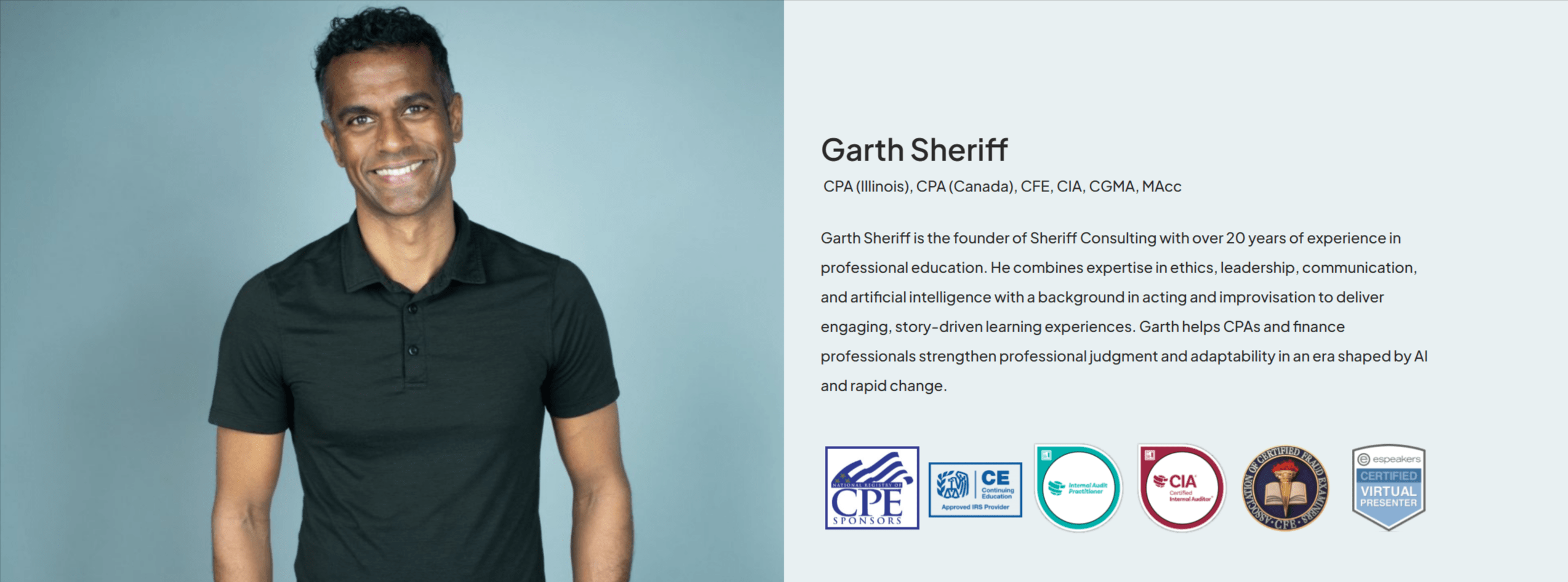
Sheriff Consulting, founded by Garth Sheriff, has built its entire curriculum around this storytelling approach.
The course library includes titles like “Professional Ethics: The Wirecard Story,” “Professional Ethics: An FTX Story,” and a course on Boeing’s governance failures. Each one takes a real corporate scandal and uses it as the framework for exploring ethical decision-making, accountability, and professional judgment. The courses are NASBA-approved and recognized by CPA regulatory bodies across the United States and Canada, and they cover the verifiable ethics CPE hours required for license renewal.
What separates the format is not just the subject matter. It is the production approach. Sheriff Consulting describes its courses as using documentary-style production designed to improve retention. The goal is not simply to transfer information, but to create an experience that professionals will actually remember.
Garth Sheriff brings a background that is genuinely unusual in the professional education space. He holds multiple accounting credentials, including CPA designations in both Illinois and Canada, a Certified Fraud Examiner designation, and the ISACA Advanced in AI Audit certification. He also has a background in acting and improvisation, having trained at The Second City and holds ACTRA membership. That combination, accounting expertise paired with performance training, shows up directly in how the courses are delivered.
Participant feedback reflects the difference. Reviews on the Sheriff Consulting site describe the approach as “refreshing,” noting that a documentary-style format made ethics content feel “engaging” rather than like a compliance obligation. Several participants specifically called out the real-life examples as what made the content stick.
Nano Learning and the Reality of the Busy Professional
One practical innovation that Sheriff Consulting has built into its model is the nano course format. Under NASBA guidelines, nano learning programs are 10-minute self-study courses that qualify for 0.2 CPE credits.
For a professional who is genuinely pressed for time, this matters. The traditional assumption that CPE has to come in multi-hour blocks is a design choice, not a regulatory requirement. Breaking content into focused, self-contained modules that can be completed in the time it takes to drink a cup of coffee is a structural acknowledgment that professionals have competing demands on their attention.
On-demand access layers on top of that flexibility. Courses in Sheriff Consulting’s library are available to start anytime, with no scheduled sessions required. The hours fly at whatever pace the professional chooses.
AI Ethics: The Curriculum That Did Not Exist Five Years Ago
Beyond fraud case studies, Sheriff Consulting has developed a dedicated line of courses focused on artificial intelligence, automation, and digital risk for accounting professionals. This reflects a genuine shift in what CPAs need to understand.
The questions around AI governance, algorithmic oversight, and the role of human judgment in an increasingly automated environment are not abstract for finance professionals anymore. Audit firms are using AI tools. Finance functions are automating processes that once required human review. The professional standards around all of this are still catching up.
Courses that address how transformative technology is reshaping assurance, governance, and financial oversight give professionals something they cannot get from a regulatory text-based ethics course: a framework for thinking about challenges that are actively changing the profession right now.
Garth Sheriff’s ISACA Advanced in AI Audit certification adds specific credibility to that part of the curriculum. This is not a general overview built around buzzwords. It reflects genuine expertise in AI governance.
Two Podcasts Worth Following
Sheriff Consulting extends its content strategy into two podcast formats. “The Fraud Complex” covers real-life fraud cases and financial betrayals in depth. “The CPA Intelligence and Ethics Show” addresses the intersection of AI advancement and the accounting profession, including the skepticism and uncertainty that many CPAs feel about what this technology means for their careers.
Both podcasts serve a function beyond entertainment. For professionals who are curious about ethics, fraud, and AI but do not want to commit to a course yet, this offers a lower-friction entry point to the ideas the curriculum covers in depth.
Accreditation and Recognition
Sheriff Consulting is registered with NASBA as a sponsor of continuing professional education on the National Registry of CPE Sponsors. Courses are recognized by CPA regulatory bodies, including CPA Ontario and CPA Alberta, along with NASBA itself. The firm has also worked with organizations including ACFE Canada and Payroll.org.
For professionals worried about whether credits will count, the accreditation trail is straightforward. These are verifiable ethics hours that satisfy the requirements of CPA licensing and renewal across the United States and Canada.
What Engaging CPE Actually Costs You
Courses in the Sheriff Consulting catalog are individually priced. “Professional Ethics: The Wirecard Story” runs 2.5 CPE hours at $135. “Professional Ethics: An FTX Story” is 2.0 hours at $100. Nano courses provide a lower-cost entry point for professionals who want to sample the approach before committing to a longer program.
For context, that is the cost of a single client dinner, or roughly an hour of professional billing, for ethics CPE that reviewers consistently describe as something they would have watched regardless of the credit requirement.
The continuing education industry is not going to abandon compliance-based training overnight. There will always be a market for low-cost, click-through ethics courses that technically satisfy a box on a renewal form.
But the professionals who actually want to develop judgment, who want to understand why sophisticated frauds go undetected for years and what that means for their own professional responsibilities, need something different.
Story-driven, on-demand ethics courses built around real corporate failures are not a gimmick. They are a better pedagogical model for adult learners who consume information primarily through narrative and who have limited tolerance for content that is not worth their time.
If your last ethics course felt like a bureaucratic obligation, it probably was. There are now options that treat your attention as something worth respecting.
Sheriff Consulting’s full course catalog is available at sheriffconsulting.com.