
How Much Should Ethics CPE Actually Cost
Nobody talks about this openly.
Ethics CPE is a mandatory expense for every licensed CPA in North America, and yet the conversation about what it should actually cost almost never happens. Most CPAs just search for something that satisfies their state board requirement, pick a price they are comfortable with, and move on.
That approach works. But it is worth understanding what you are actually buying at different price points, because the gap between a fifteen-dollar ethics course and a properly built one is not just a number. It is the difference between education that disappears the moment you close the browser and education that actually changes how you think on the job.
What the Market Actually Looks Like
Ethics CPE pricing across the U.S. and Canada runs a wide range. At the low end you will find self-study courses priced between ten and thirty dollars, often sold as part of bulk CPE subscription packages where ethics is essentially a loss leader. In the mid range, standalone ethics courses from reputable NASBA-approved providers typically run between fifty and one hundred and fifty dollars for a four-hour course. At the premium end, courses built around real case studies, delivered by credentialed practitioners with significant professional experience, sit above that range and charge accordingly.
For Canadian CPAs completing CPD requirements, pricing follows a similar pattern. Provincial bodies and independent providers both operate in this space, and the same quality variation exists.
The price difference is not arbitrary. It reflects real decisions made during course development about who builds the content, how it is structured, what research informs it, and how much professional expertise goes into the delivery.
What Cheap Ethics CPE Is Actually Cutting
When an ethics course is priced at the very bottom of the market, something has been sacrificed to get it there. Usually several things.
The most common cut is in course development. Low-cost ethics CPE is often built around a generic walkthrough of the AICPA Code of Professional Conduct, recycled from a template that has circulated for years. There is nothing technically wrong with this content. It covers the rules. It will satisfy most state boards. But it is built for compliance, not comprehension, and it shows.
The second cut is in instructional depth. Courses designed to be completed as quickly as possible tend to be structured around passive consumption and multiple-choice quizzes with enough attempts to guarantee a passing score. The learner is not challenged. Nothing uncomfortable or genuinely thought-provoking appears. The certificate arrives and the experience is immediately forgotten.
The third cut is in real-world application. Inexpensive ethics CPE almost never uses actual fraud cases or documented ethical failures as teaching material. This matters more than it might seem. Research on professional learning consistently shows that narrative-driven content grounded in real situations yields significantly higher retention than abstract rule reviews. When you learn ethics through the lens of what actually happened to real professionals in real organizations, the lessons attach to something meaningful in your memory. When you learn ethics through a bullet-point summary of professional standards, they attach to nothing at all.
What You Are Actually Paying For at the Premium End
A well-built ethics CPE course costs more to develop and more to deliver. The instructors are credentialed practitioners with direct professional experience in the subject matter. The content is built around documented cases, researched in forensic detail, and structured to challenge the learner’s thinking rather than simply confirm what they already know.
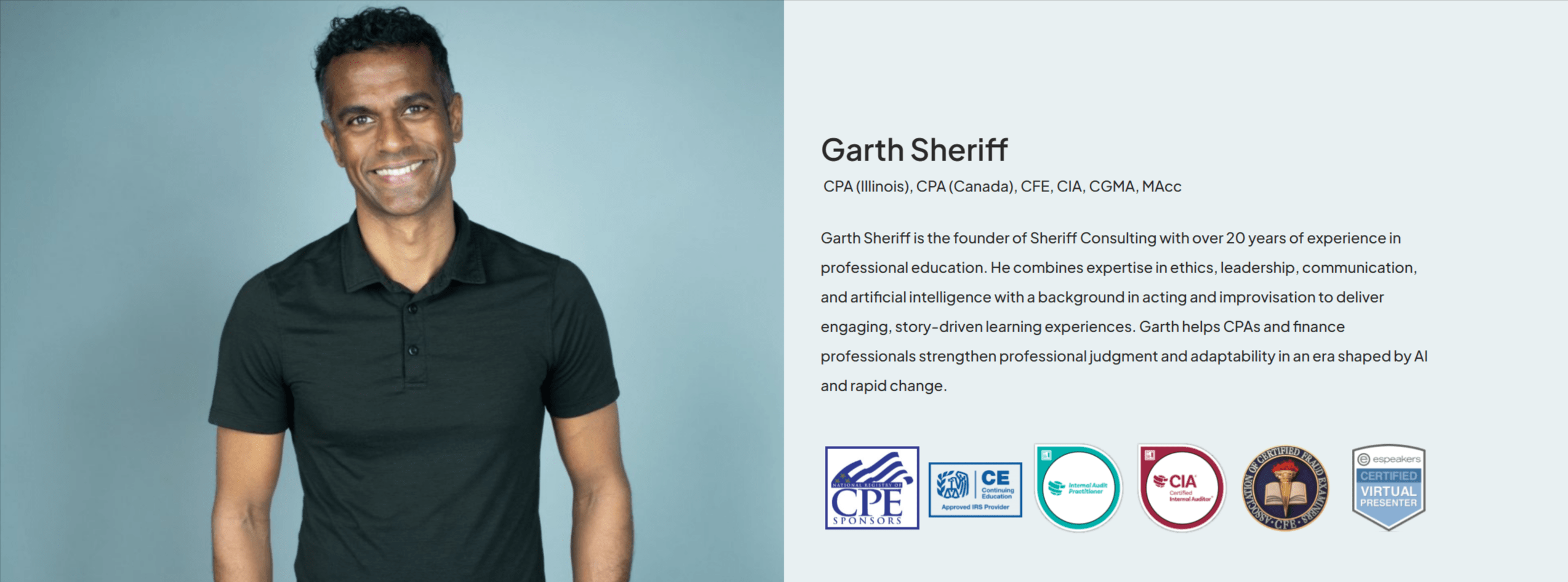
At Sheriff Consulting, the ethics CPE courses for U.S. CPAs and the CPD programs for Canadian professionals are built and delivered by Garth Sheriff, a CPA licensed in both Illinois and Canada and a Certified Fraud Examiner with over twenty years of professional education experience. Every course is NASBA-approved and built around real cases including Wirecard, FTX, Boeing, and WorldCom, analyzed with the same forensic attention you would bring to a professional engagement.
That is not a product pitch. It is an explanation of where the cost goes in a course built this way versus one built to a price point.
The Real Cost of Cheap Ethics CPE
Here is the calculation that most CPAs do not run.
Your ethics CPE requirement is typically four hours every two years. Over a thirty-year career that is roughly sixty hours of ethics education. If you spend those sixty hours in courses that leave no impression, you have invested a significant amount of time and achieved essentially nothing beyond license compliance.
The actual cost of cheap ethics CPE is not the money you saved. It is the professional judgment you did not develop. Judgment that, at some point in a thirty-year career, you will need.
The CPA who walks into a genuinely difficult ethical situation, the kind where the pressure is real, and the rationalizations are compelling, is not protected by having passed a multiple-choice quiz on the AICPA code. They are protected by having thought seriously about how these situations actually unfold, what the warning signs look like, and how good professionals end up making decisions they later regret.
That kind of preparation comes from education built for it. If you want ethics CPE that is worth the hours you put into it, explore the full course catalogue at Sheriff Consulting for U.S. CPAs or the CPD programs available for Canadian professionals. And if you want to go deeper on the real fraud cases that define modern professional ethics, subscribe to The Fraud Complex, the podcast that breaks down the world’s most consequential financial scandals every week.