
CPA Ethics: When Good Accountants Make Bad Decisions
We like to think ethical failures in accounting are committed by bad people. Greedy executives. Reckless auditors. Professionals who knew exactly what they were doing and did it anyway.
But the truth is more uncomfortable than that.
Some of the most significant financial scandals in history were carried out, or enabled, by intelligent, credentialed, well-respected professionals. People who, by most measures, were considered good at their jobs and good in their communities.
So what went wrong?
That is the question worth sitting with. Not just as an intellectual exercise, but as a career-long practice. Because understanding why good accountants make bad decisions might be the most important thing you ever do for your professional future.
The Myth of the Obvious Villain
When we study cases like Wirecard, Boeing, or FTX after the fact, the red flags can seem almost laughably obvious in hindsight. We ask ourselves how anyone could have missed this. How did trained professionals sign off on this? How did no one speak up?
But hindsight is a luxury that real-time decision-making does not offer.
In the moment, decisions rarely feel like ethical crossroads. They feel like judgment calls. Practical compromises. Reasonable accommodations given the pressure and context of the situation.
That gap between how decisions feel in the moment and how they look in a courtroom years later is where ethical lapses are born.
At Sheriff Consulting, we have built entire ethics CPE courses around this idea. Real cases. Real professionals. Real consequences. Because we believe the best way to prepare for ethical pressure is to understand exactly how it operates.
Rationalization: The Brain’s Defense Mechanism
The most common psychological driver behind ethical lapses is not greed. It is rationalization.
Rationalization is the process of constructing a logical justification for a decision you have already emotionally committed to. It happens fast, often unconsciously, and it is remarkably convincing.
According to research from the Behavioral Ethics Lab at the University of Notre Dame, most unethical behavior in professional settings is not the result of deliberate wrongdoing. It is the result of psychological blind spots that cause otherwise ethical people to act in ways that contradict their own values without fully realizing it.
A few of the most common rationalizations in the accounting world include:
“Everyone does it this way.” When a questionable practice becomes normalized within a firm or industry, it stops feeling questionable. It becomes standard operating procedure. The problem is that normalized deviance, as researchers call it, tends to escalate over time. What starts as a minor grey area slowly becomes something much more serious.
“I am just doing my job.” This is one of the most dangerous rationalizations a professional can reach for. It creates psychological distance between the individual and the outcome of their actions. It shifts moral responsibility elsewhere. And it is particularly common in hierarchical environments where pressure comes from above.
“No one is really getting hurt.” Financial harm is often invisible, especially in the early stages of a fraud or ethical breach. When there is no obvious victim in front of you, it becomes easier to minimize the impact of your decisions.
Understanding these patterns is not just interesting psychology. It is practical professional development. The CPD courses available for Canadian and international CPAs through Sheriff Consulting are designed specifically to help professionals recognize these patterns before they become costly.

The Pressure Cooker
Rationalization rarely operates in isolation. It almost always comes with company, and that company is pressure. Deadline pressure. Revenue pressure. Client retention pressure. Pressure from partners, managers, and supervisors who have made it very clear what outcome they are hoping for.
Research in behavioral CPA ethics consistently shows that professionals under pressure are significantly more likely to compromise their standards, often without fully realizing it. The brain under stress narrows its focus. Long-term consequences become abstract. Immediate relief becomes the priority.
This is why ethics training that only covers the rules is not enough. Knowing that something is wrong does not automatically protect you when you are three days from a deadline, your managing partner is breathing down your neck, and a client relationship worth seven figures is on the line.
What actually helps is having thought through these scenarios in advance. Having internalized not just the what but the how. How do I respond in this moment? What do I say? What do I document? Who do I talk to?
That is the kind of practical, scenario-based thinking we explore in depth on The CPA Intelligence and Ethics Show, our podcast for CPAs navigating a fast-changing profession.
The Slippery Slope Is Real
One of the most well-documented phenomena in ethical psychology is what researchers call ethical fading. Over time, repeated small compromises recalibrate your internal moral compass. What once felt uncomfortable starts to feel normal. And what feels normal stops triggering any internal alarm bells at all.
This is the slippery slope, and it is not a cliche. It is a documented psychological process.
The Wirecard case is a masterclass in this pattern. The fraud did not start as a multi-billion-dollar scheme. It started with smaller manipulations, small enough to rationalize, small enough to feel manageable. By the time the full picture emerged, the people involved had been gradually conditioned to accept each incremental step.
The Association of Certified Fraud Examiners estimates that organizations lose roughly five percent of their annual revenue to fraud each year, with a significant portion of cases involving professionals who had no prior history of misconduct. That statistic alone tells you everything about how gradual ethical erosion operates in real professional environments.
We break this case down in forensic detail in our Professional Ethics: A Wirecard Story course. If you want to understand how ethical fading operates in practice, this is one of the most instructive examples in modern financial history.
Identity and the “Good Person” Trap
Here is one of the more counterintuitive findings in CPA ethics research. People who strongly identify as ethical are sometimes more vulnerable to certain types of ethical lapses, not less.
The reason is a concept called moral licensing. When you have a strong self-image as an honest, principled professional, your brain can unconsciously use that identity as credit. You have been good for so long that this one exception feels permissible. You have earned it. You are not the kind of person who would do something truly wrong, so this cannot really be that wrong.
This is uncomfortable to read because it applies to exactly the kind of person who pursues professional designations, completes their ethics CPE every year, and takes their responsibilities seriously.
Which is precisely why it is worth knowing.
What You Can Actually Do About It
Awareness is the starting point, but it is not sufficient on its own. Here are the practices that behavioral CPA ethics research and professional experience suggest actually make a difference.
Slow down the decision. Most rationalizations thrive on speed. Creating a deliberate pause before significant professional judgments gives your reflective brain a chance to catch up with your reactive brain.
Name the pressure out loud. Simply labeling the pressure you are experiencing, whether to yourself, a trusted colleague, or a mentor, reduces its power. It moves the dynamic from something you are navigating alone to something you are consciously evaluating.
Use a pre-mortem. Before making a consequential judgment call, ask yourself what this decision looks like if it ends up on the front page of a financial publication two years from now. This is not paranoia. It is professional prudence.
Invest in ongoing CPA ethics education. Not just to meet your CPE requirements, but to keep your thinking fresh. Exposure to how these situations actually unfold builds intuition that abstract rules simply cannot.
Listen to the discomfort. If something feels off, that feeling is data. Ethical instincts are developed over time through education and experience. When they fire, they deserve more than a quick rationalization.
The Bigger Picture
The accounting profession is built on trust. That trust is not just a professional obligation. It is the foundation of functioning capital markets, of investor confidence, and of the value CPAs bring to every client and organization they serve.
Protecting that trust is not a passive act. It requires active, ongoing attention to the psychological forces that can quietly erode professional judgment under the right conditions.
Good accountants make bad decisions for understandable, predictable, human reasons. The professionals who navigate their careers with integrity are not immune to those forces. They are the ones who understand them.
That understanding starts with education. If you are looking for ethics CPE that actually challenges your thinking and prepares you for the real pressures of professional life, explore our full course catalog for U.S. CPAs or our CPD programs for Canadian and international professionals.
And if you want to go deeper on the cases that define modern professional ethics, subscribe to The Fraud Complex, our podcast that pulls back the curtain on the world’s most audacious real-life fraud cases every week.
Because the best defense against an ethical lapse is understanding exactly how one happens.
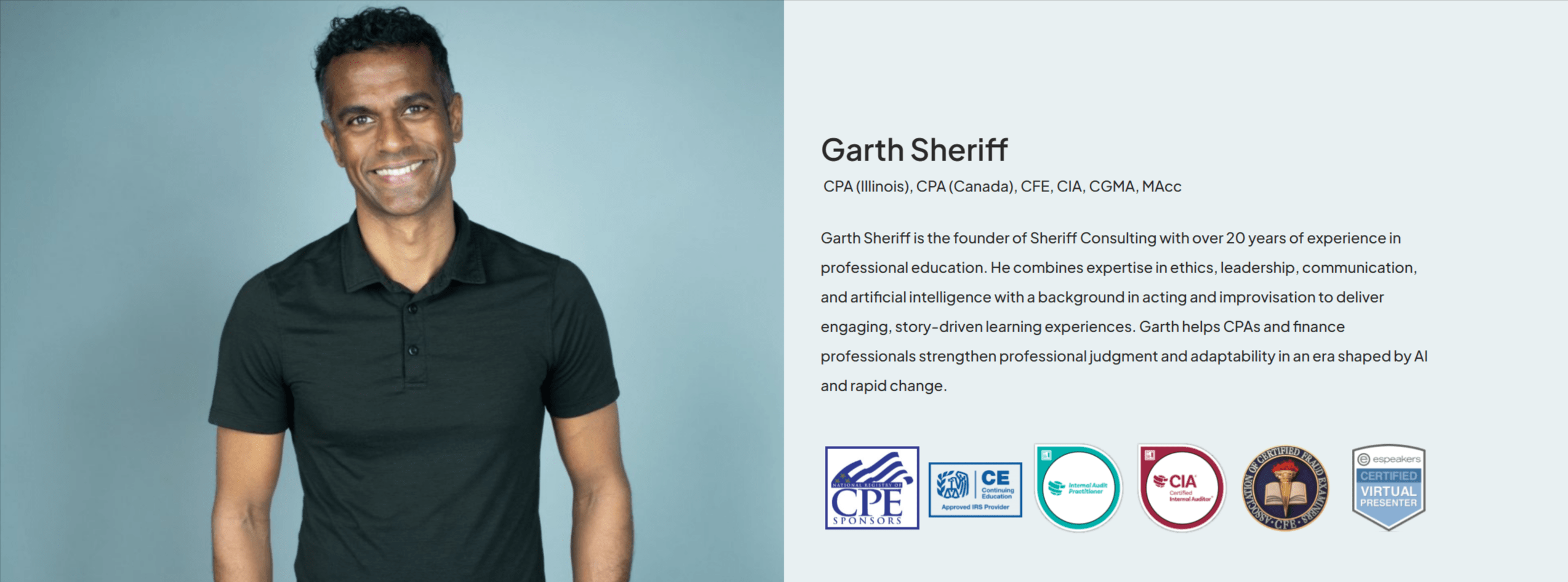
Garth Sheriff is a CPA (Illinois), CPA (Canada), CFE, and founder of Sheriff Consulting. He has spent over 20 years helping finance professionals develop the ethical judgment and technical knowledge they need to navigate a rapidly changing profession. Learn more at sheriffconsulting.com.