
How to Choose Ethics CPE That Actually Makes You a Better CPA
Most CPAs treat ethics CPE the same way they treat a dental cleaning. You know you have to do it. You schedule it as late as possible. You get through it. And then you do not think about it again for another two years. That approach will keep your license active. It will not make you a better professional.
The difference between ethics CPE that checks a box and ethics CPE that genuinely sharpens your judgment is significant. And in a profession built entirely on trust, that difference matters more than most CPAs are willing to admit.
Here is how to choose ethics CPE that actually benefits your career.
Start With What Your State Actually Requires
Before you enroll in anything, know exactly what your state board demands. Ethics CPE requirements vary considerably across jurisdictions, and the variation creates a trap that catches more CPAs than it should.
Most states require between two and four hours of ethics CPE per renewal period. Some states require a board-approved course from a specific list of providers. Others accept any NASBA-approved ethics content. New York, for example, will not accept behavioral ethics as a substitute for professional ethics, categorizing it in a different subject area entirely. Florida requires courses approved directly by the Florida Board of Accountancy, meaning a NASBA-approved course from another state does not automatically qualify.
The NASBA Registry is the most reliable place to verify your state’s specific requirements. If you already know your state accepts NASBA-approved content, you can browse the ethics CPE courses for U.S. CPAs at Sheriff Consulting straight away.
For Canadian CPAs, CPD requirements are governed by your provincial body, and the same principle applies. Know what counts before you commit.
Check the Credentials Behind the Course
Not all ethics CPE is created equal, and the credentials of the people developing and delivering the content matter more than the price point or the production value of the website selling it.
Under NASBA standards, a qualifying CPE course must include at least one licensed CPA in its development. That requirement exists for a reason. Ethics education that is built by practitioners who have sat in the same seat as the professionals taking the course tends to be considerably more relevant than content developed by instructional designers with no background in public accounting.
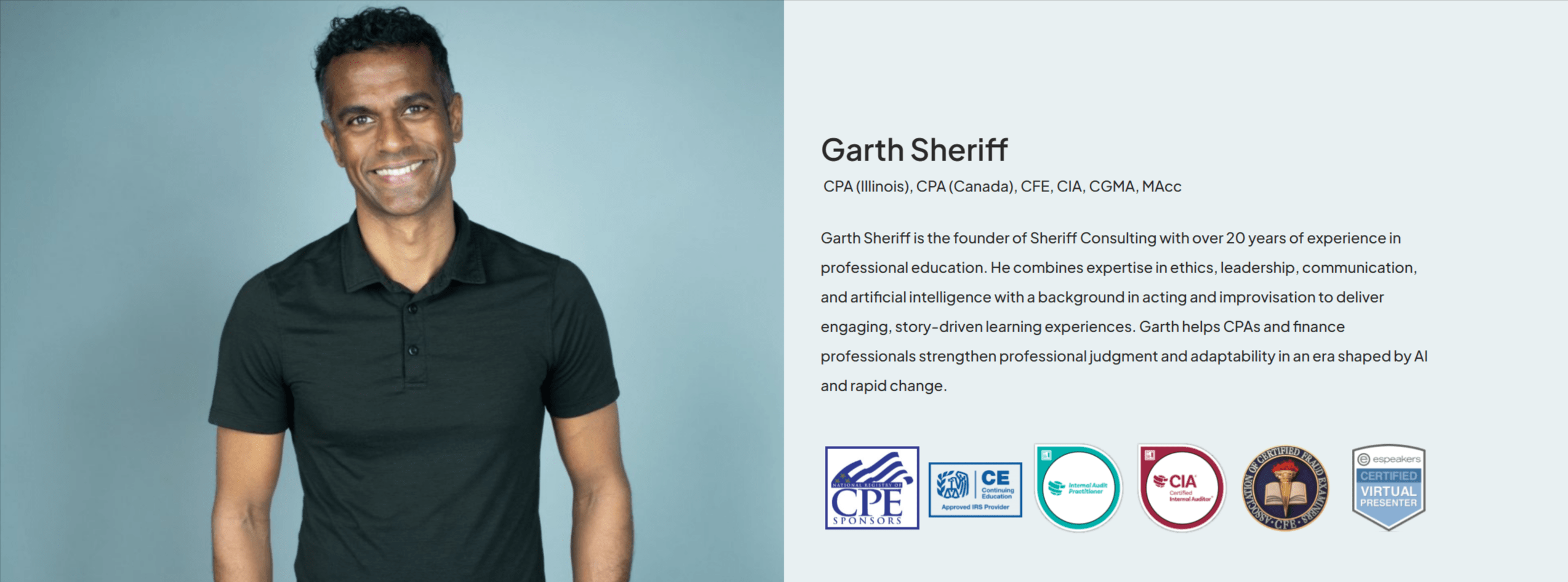
At Sheriff Consulting, every ethics CPE course is developed and delivered by Garth Sheriff, a CPA licensed in both Illinois and Canada, a Certified Fraud Examiner, and a holder of the ISACA Advanced in AI Audit certification. The content reflects over two decades of experience in professional education, not a generic curriculum built to satisfy minimum standards.
Look for Real Cases, Not Abstract Rules
This is the single most important factor in choosing ethics CPE that will actually change how you think.
Rules-based ethics training tells you what is prohibited. It covers the AICPA Code of Professional Conduct, reviews the standards, asks you a few multiple-choice questions, and issues a certificate. It is forgettable almost immediately because there is nothing for your brain to attach the information to.
Story-based learning works differently. Research consistently shows that narrative-driven content enhances retention and promotes critical thinking by immersing learners in emotionally relevant situations, creating deeper connections than abstract instruction ever can. When you learn ethics through the lens of a real fraud case, with real professionals making real decisions under real pressure, the lessons become part of how you think rather than a checklist you reviewed once and filed away.
This is why Sheriff Consulting builds its courses around cases like the Wirecard collapse, the Boeing ethics scandal, and the FTX implosion. These are not hypotheticals. They are documented, forensically analyzed case studies of how ethical failures actually happen to credentialed professionals in high-pressure environments. That is the kind of education that stays with you.
The Question Worth Asking Before You Enroll
Before you commit to any ethics CPE course, ask yourself one question: Will I think differently about a real ethical situation after completing this?
If the honest answer is probably not, find a different course. If the content is a dry walkthrough of standards you already know, delivered by someone you will never interact with, requiring nothing more than a passing score on a multiple choice quiz, you are checking a box. You are not investing in your career.
The CPAs who navigate their careers without ethical incident are not the ones who simply stay compliant. They are the ones who kept their judgment sharp, stayed current on how ethical failures actually unfold, and treated continuing education as a genuine professional practice rather than an administrative obligation.
If you are looking for ethics CPE built around real cases and designed to prepare you for the pressures of actual professional life, explore the full range of ethics CPE courses for U.S. CPAs and CPD programs for Canadian professionals at Sheriff Consulting.
And if you want to go deeper on the fraud cases that define modern professional ethics, subscribe to The Fraud Complex, the podcast that pulls back the curtain on the world’s most consequential real-life fraud cases every week.
Your license renewal deadline will come regardless. The question is whether you use it.
Garth Sheriff is a CPA (Illinois), CPA (Canada), CFE, and founder of Sheriff Consulting. He has spent over 20 years helping finance professionals develop the ethical judgment and technical knowledge they need to navigate a rapidly changing profession. Learn more at sheriffconsulting.com.